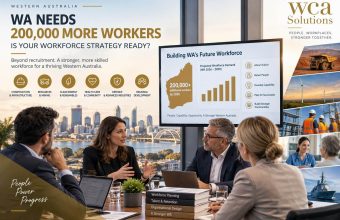
WA Needs 200,000 More Workers: Is Your Workforce Strategy Ready?
Western Australia is entering a critical period of workforce demand. Major investments across construction, resources, clean energy, health care, defence, infrastructure and regional development are creating unprecedented pressure on the state’s labour market.
Recent forecasts suggest Western Australia could require more than 200,000 additional workers over the coming decade to meet projected economic demand. At the same time, the resources sector continues to operate at record employment levels, underpinned by a significant project pipeline and ongoing investment.
For many employers, the challenge is no longer finding the next employee. The challenge is building a workforce strategy capable of sustaining growth in an increasingly competitive labour market.
At WCA Solutions, we believe organisations need to move beyond vacancy management and adopt a long-term workforce planning approach that addresses capability, retention, succession and organisational design.
The Skills Shortage Is Not a Future Problem
Many organisations continue to treat workforce shortages as a recruitment issue.
When a position becomes vacant, the response is often straightforward: recruit a replacement. However, this reactive approach is becoming increasingly difficult as competition for skilled workers intensifies across multiple industries.
Western Australia’s workforce challenge is being driven by several interconnected factors:
- Significant economic and project growth across multiple sectors
- Competition for talent between industries
- Ageing workforce demographics
- Increasing demand for specialised technical skills
- Regional workforce shortages
- Changing employee expectations regarding flexibility, development and purpose
- Ongoing workforce mobility across Australia and internationally
These factors mean organisations cannot simply recruit their way out of workforce shortages.
Why Recruitment Alone Is Not Enough
Recruitment remains an important component of workforce strategy, but organisations that focus exclusively on attracting talent often overlook the factors that determine long-term workforce sustainability.
The most successful organisations are asking broader questions:
- Do we have the workforce capability required to execute our strategy?
- Which critical roles will become difficult to fill over the next five years?
- What workforce risks exist within our leadership pipeline?
- How vulnerable are we to employee turnover?
- Are we developing future talent internally?
- Does our employment proposition differentiate us from competitors?
Without addressing these questions, employers may find themselves trapped in a continuous cycle of recruitment, turnover and workforce instability.
Shifting From Vacancy Management to Workforce Planning
Workforce planning is the process of ensuring an organisation has the right people, with the right skills, in the right roles, at the right time.
Rather than focusing solely on current vacancies, workforce planning examines future workforce requirements and develops strategies to address emerging capability gaps before they become business risks.
Effective workforce planning considers:
Workforce Demand
Understanding how growth, projects, market conditions and business strategy will affect future workforce requirements.
Workforce Supply
Assessing current workforce demographics, capability levels, turnover trends and succession risks.
Capability Requirements
Identifying the skills and competencies needed to support future organisational objectives.
Workforce Risks
Evaluating areas where talent shortages, retirements, turnover or competition may create operational challenges.
Workforce Solutions
Developing practical strategies involving recruitment, retention, development, succession planning, organisational design and workforce flexibility.
The Retention Advantage
Many organisations focus heavily on attraction strategies while overlooking retention opportunities.
Replacing experienced employees is often significantly more expensive than retaining them.
When key employees leave, organisations may lose:
- Operational knowledge
- Technical expertise
- Leadership capability
- Customer relationships
- Productivity
- Team stability
Employers that invest in employee engagement, career pathways, development opportunities and leadership effectiveness are often better positioned to reduce workforce risk and improve organisational performance.
Retention is no longer simply an HR objective. It is a strategic workforce priority.
Capability Development Is Becoming a Business Imperative
As industries evolve, the skills required to perform work are changing.
Technology adoption, automation, sustainability requirements and operational transformation initiatives are increasing demand for new capabilities across many sectors.
Employers must consider:
- Which future skills will our organisation require?
- Which capabilities can be developed internally?
- Where will external talent be required?
- How quickly can we close capability gaps?
Organisations that build strong learning and development frameworks today will be better prepared to compete for talent tomorrow.
Succession Planning Cannot Wait
Many organisations understand succession planning is important but delay implementation until a key employee resigns or retires.
Effective succession planning identifies future leaders and critical role successors before workforce gaps emerge.
Key considerations include:
- Leadership pipeline strength
- Critical position risk assessments
- Internal talent identification
- Development pathways
- Knowledge transfer planning
- Workforce continuity strategies
In a tight labour market, succession planning becomes a competitive advantage.
Five Questions Every WA Employer Should Be Asking
As workforce pressures increase, organisational leaders should ask:
1. What workforce capabilities will we need in 2027, 2030 and beyond?
2. Which critical positions would create operational risk if they became vacant tomorrow?
3. Is our employee value proposition strong enough to attract and retain talent?
4. Do we have a succession pipeline for key leadership and technical roles?
5. Is our workforce strategy aligned with our business strategy?
If these questions are difficult to answer, it may be time to review your workforce planning framework.
The Organisations That Plan Will Win
Western Australia’s workforce challenge is unlikely to be solved through recruitment alone.
The organisations best positioned for future success will be those that proactively invest in workforce planning, talent development, retention, succession and organisational capability.
As competition for skilled workers continues to increase, workforce strategy will become one of the most important drivers of organisational performance.
Employers who continue to focus only on filling vacancies may find themselves permanently responding to workforce shortages.
Those who plan strategically will build the workforce capability required to support sustainable growth.
How WCA Solutions Can Help
WCA Solutions supports organisations across Western Australia with:
- Strategic workforce planning
- Organisational design
- Talent and succession planning
- Remuneration and reward frameworks
- Employee value proposition (EVP) development
- Capability and leadership development
- Workforce risk assessments
- HR and workforce strategy development
Through our workforce planning expertise and WCA Talent retained search capability, we help organisations move beyond recruitment and develop sustainable workforce strategies that support long-term business success.
The future workforce challenge is bigger than filling vacancies. The organisations that succeed will be those that plan today for the workforce they need tomorrow.
Contact WCA Solutions to discuss your workforce planning, talent and organisational capability requirements.